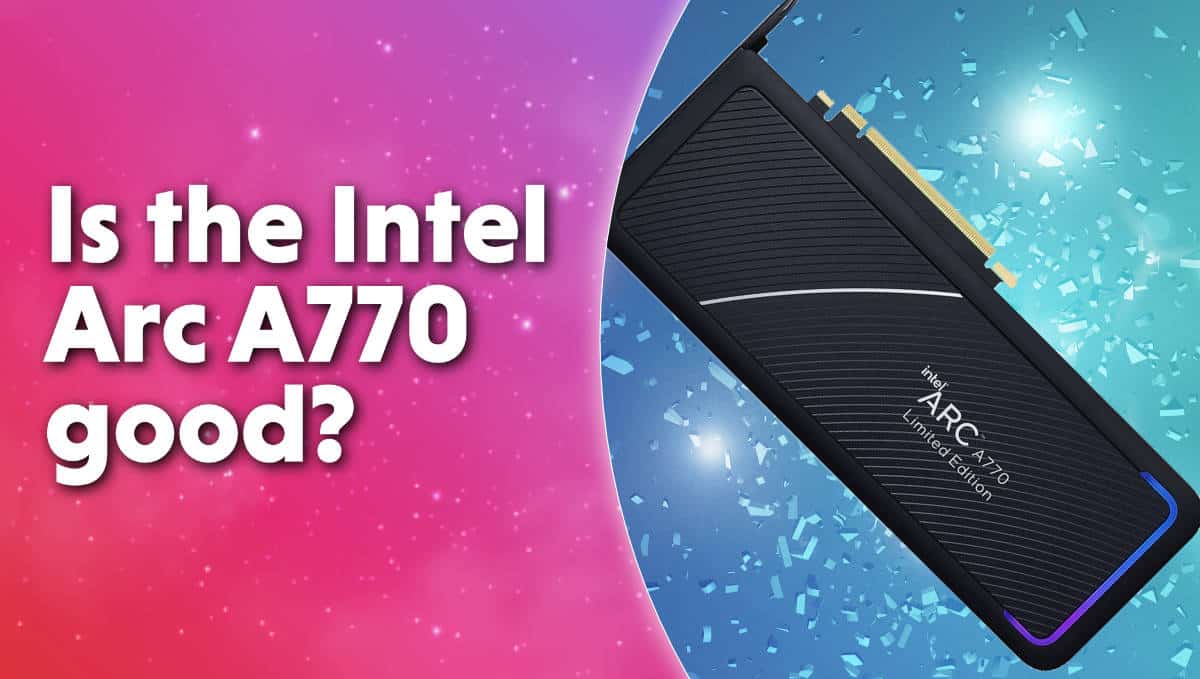
Is the Intel Arc A770 good?
Finally a third competitor, but is the new selection any good?

Share this article...

WePC is reader-supported. When you buy through links on our site, we may earn an affiliate commission. Prices subject to change. Learn more
The Intel Arc A770 is far from being a high-end graphics card. When it comes to performance, it cannot compete with the version of the Nvidia GeForce RTX 3080 or AMD Radeon RX 6800. Let alone the new choices of RTX 4000 or RDNA 3.
However, many people are satisfied with playing on cards that aren’t as powerful as these. The Arc A770 is actually worthy of consideration if you’re looking for a more midrange solution that prioritizes running more modern DX12 games.
The Arc A770 is a first-generation Xe HPG graphics card that is based on the Alchemist architecture. A 406mm², made with TMSCs 6nm process is a feature of all Arc A770 graphics cards. 32 Texture Sampler partitions and 128 Ray Tracing Units (RTUs) are also present in the Intel Arc A770 graphics card.
The clock speed of the A770 graphics card is 2,100MHz. Additionally, the GPU core has hardware for sorting the workload for ray-tracing activities in order to enhance the gaming experience. As a result, each RTU can process up to 12 box intersections and one triangle intersection at peak throughput.
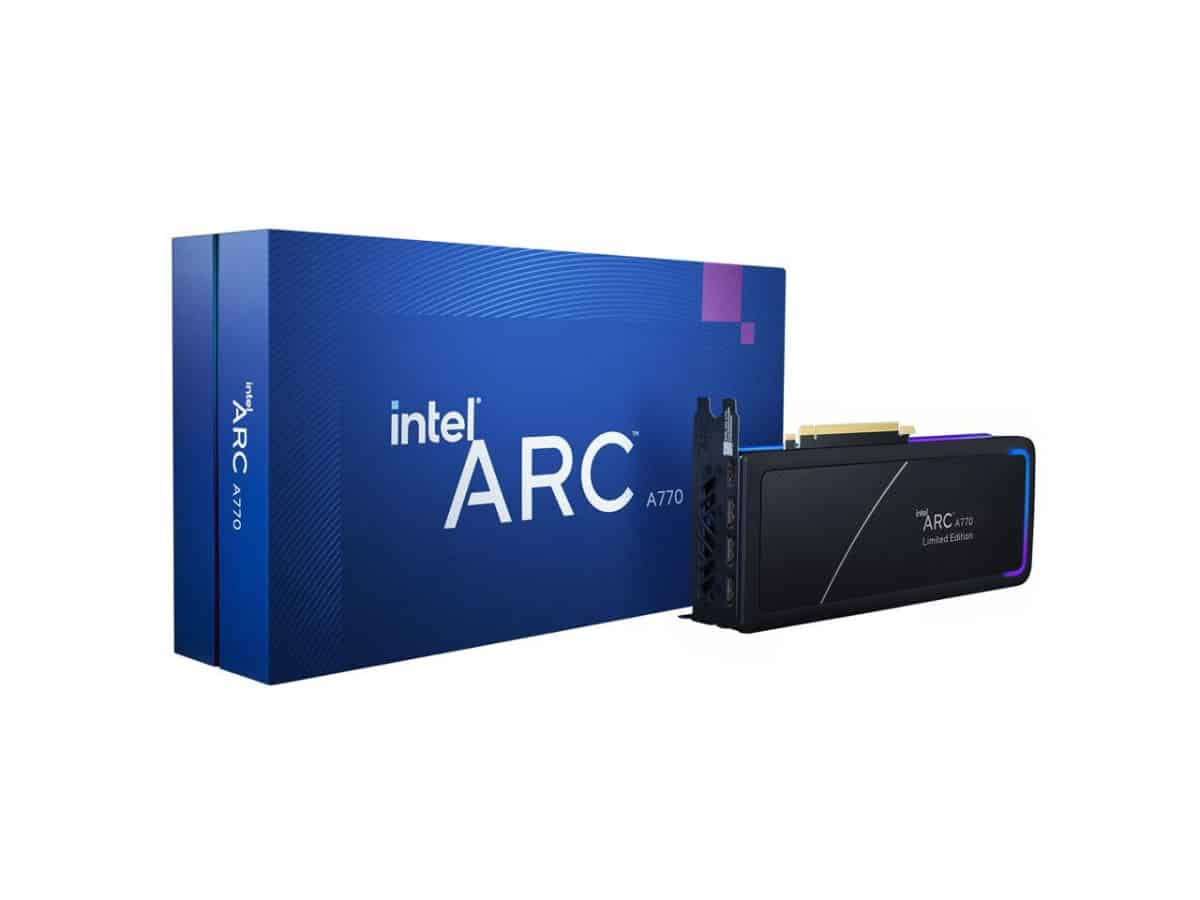
There are undoubtedly a few rough edges on Intel’s Arc A770 Limited Edition graphics card that needs to be improved. Little testing with legacy games indicates that its performance in older games is inferior compared to other models in its price range; also, its idle power demand is excessively high.
However, the card has advantages too. Due to its large VRAM, the Arc A770 stands out against its closest rivals, especially at higher resolutions. Even if the card has issues with older games, it’s likely that these problems will get better with time.
You can determine whether you would purchase this card for personal use according to your gaming needs. However, you can buy one for personal usage given the present performance numbers and considering you would game at 1440p or 4K.
Recent games run smoothly on it, and the enormous RAM pool makes it difficult to switch to another system. The Arc A770 is a highly promising card and may likely improve over time, but driver improvements and more consistency are still unquestionably required.
Is the Intel Arc A770 worth it?
With the powerful GPUs present in the market, Intel has released the Intel Arc A770 Limited Edition. It comes with 16GB VRAM, costs $349, and is based on the “alchemist architecture”. It is one of the best-looking graphics cards present in the market. It has a backplate covered in matte black, giving it a smart look.
Intel has introduced a new feature in the A770 known as XeSS. It is quite similar to the DLSS feature of Nvidia. It renders the frames at a low resolution and upscales them to the resolution you are playing games at. This is a great way to give a boost to your frame rates. In some games, particularly Hitman 3, it offers significant advantages and makes enough difference that you can opt to use ray tracing.
In the end, DLSS still seems to have the advantage when offered; thus, if you have an Nvidia card, you should probably always choose it. However, it is worthwhile to enable the Arc A770.
Even if XeSS is still new and will develop further, the A770 complements it perfectly. It takes a lot of close inspection to spot any image quality concerns on ultra settings. It appears just as good at 1440p as it does when it is off with the casual eye. The first-generation architecture used by the Intel Arc A770 offers incredible performance at 2k and 4k, respectively.
You can be strongly tempted to purchase one of these cards for personal usage, given the present performance numbers and the assumption that you would game at 1440p or 4K. Recent games run smoothly on it, and the enormous VRAM pool makes it difficult to switch to another system. The Arc A770 is a highly promising card and may likely improve over time, but driver improvements and more consistency are still unquestionably required.